When Your Org Chart Becomes a Strategic Liability
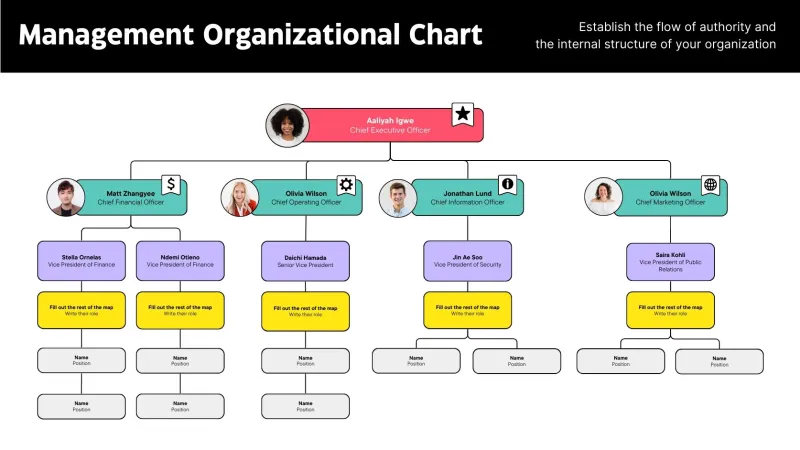
Photo: corporate organizational hierarchy structure business meeting executives whiteboard, via marketplace.canva.com
There is a particular kind of organizational frustration that leaders rarely name directly. The strategy was sound. The leadership team was aligned. The presentation earned genuine enthusiasm. And yet, six months into execution, progress has stalled, accountability has blurred, and the initiative that once seemed inevitable now feels impossibly distant.
In many cases, the culprit is not a failure of will or intelligence. It is structure.
Organizational design is one of those disciplines that receives serious attention during a company's founding, then quietly calcifies as the business matures. Reporting lines get added to accommodate individuals rather than functions. Departments form boundaries that harden into walls. Committees multiply to manage the friction that structure itself created. By the time a new strategic direction is introduced, the organization has often evolved into something optimized for a version of the business that no longer exists.
The Structural Debt Most Leaders Ignore
In financial terms, technical debt refers to the accumulated cost of shortcuts taken during development — decisions that were expedient at the time but compound into liabilities over the long run. Organizational structure carries a remarkably similar dynamic.
Every time a company reorganizes around a crisis, creates a new role to retain a high performer, or layers a matrix structure over an existing hierarchy to solve a coordination problem, it accrues what might be called structural debt. These decisions rarely feel significant in isolation. Collectively, they produce organizations where authority is ambiguous, decision rights are contested, and information travels along paths that were never deliberately designed.
When a new strategy enters this environment, it does not move through a neutral medium. It moves through a system shaped by years of accumulated compromise — and that system has its own logic, its own immune responses, and its own gravitational pull toward the status quo.
How Misalignment Manifests in Practice
The structural impediments to strategy tend to surface in recognizable patterns, even when their root cause goes undiagnosed.
Accountability without authority. A business unit is held responsible for outcomes it cannot actually control because the functions it depends on — technology, finance, legal — report to a different executive with different priorities. The result is a performance review culture built around explaining failure rather than enabling success.
Strategic initiatives that belong to no one. Cross-functional priorities frequently fall into the gaps between departments. Each group contributes what falls within its defined scope, but no single owner has the mandate or the resources to drive the initiative as a whole. These efforts tend to generate activity without producing results.
Information that travels upward instead of laterally. In heavily hierarchical organizations, the fastest route between two departments often runs through the C-suite. This is not merely inefficient — it distorts the quality of information at every level, as data is filtered, summarized, and politically shaped before it reaches the people who need to act on it.
Incentive structures that reward the wrong behavior. When compensation and advancement are tied to departmental performance, rational employees will protect their department's interests even when doing so undermines broader strategic goals. This is not a character flaw. It is a structural design problem masquerading as a culture problem.
A Framework for Diagnosing Structural Impediments
Before any meaningful structural intervention can occur, leadership needs a clear-eyed diagnosis of where the current design is creating friction. The following framework provides a starting point.
Map the strategy's critical paths. Identify the two or three capabilities that your strategy depends on most heavily. For each one, trace the organizational journey required to activate that capability — which functions are involved, who makes decisions, where approvals are required, and where handoffs occur. This exercise frequently reveals that the most important strategic work crosses the most organizational boundaries.
Identify decision rights gaps. For each major strategic initiative, ask explicitly: who has the authority to make the decisions required to move this forward? If the answer involves committees, consensus requirements, or escalation to executives who are already overextended, the initiative is structurally under-resourced regardless of its priority ranking.
Audit incentive alignment. Review how the leaders responsible for executing strategy are actually evaluated and rewarded. Where performance metrics are purely departmental, expect departmental behavior — even when the stated priority is enterprise-wide.
Test for information flow. Conduct informal interviews across levels and functions to understand how strategic direction is communicated, interpreted, and translated into action. The distance between what the executive team believes the strategy means and what a front-line manager believes it means is often a reliable indicator of structural dysfunction.
Redesigning for the Strategy You Have, Not the History You Carry
The goal of structural realignment is not to produce an elegant org chart. It is to remove the friction between strategic intent and operational execution.
This typically requires a willingness to make decisions that feel uncomfortable in the short term. Consolidating functions that have operated independently for years will generate resistance. Eliminating layers that provide visible status to their occupants will create political tension. Redefining decision rights will unsettle leaders who have built their influence on ambiguity.
None of this is a reason to avoid the work. It is, rather, a reason to approach it with both rigor and deliberateness — understanding that structural change is not an event but a process, and that the most durable realignments are those that bring the affected stakeholders into the diagnostic conversation rather than presenting them with conclusions.
Organizations that consistently execute on strategy are not, in my experience, distinguished by the sophistication of their strategic frameworks. They are distinguished by the degree to which their structure, their decision-making processes, and their incentive systems are coherently aligned with the direction they are trying to move.
The Diagnostic Conversation Worth Having
If your organization has experienced repeated cycles of ambitious strategy followed by disappointing execution, the instinct is often to question the strategy itself — to revisit the analysis, refine the priorities, and produce a sharper plan. That instinct is understandable, but it frequently addresses the symptom rather than the cause.
The more productive question is structural: does the way we are organized actually enable the strategy we are trying to execute, or are we asking people to deliver results that the current design makes structurally improbable?
Answering that question honestly — and then acting on the answer — is among the most consequential things a leadership team can do. It is also, in my view, one of the most neglected dimensions of strategic consulting practice.
Structure is not a neutral backdrop to strategy. It is either an accelerant or an anchor. The organizations that recognize this distinction, and act on it with discipline, tend to be the ones that close the gap between what they intend and what they actually achieve.